The Difference Between UX and UI Design – A Beginner’s Guide
- SACHIN Creation World
- Nov 11, 2022
- 5 min read

UX and UI: Two terms that are often used interchangeably, but actually mean very different things. So what exactly is the difference?
Learn about the differences between UI and UX (and which might be a better career for you).
User interface (UI) and user experience (UX) are two words that you might hear mentioned frequently in tech circles (and sometimes interchangeably). But what do the terms actually mean, and what does it mean to be a UX or UI designer?

We’ve all overheard conversations, walking down hip streets of the world’s tech capitals, discussions about the great ‘UX’ of a product, or the poor ‘UI’ of a website. Is it a secret language you will never be privy to? Are these people just using slang to look cool? Well, okay, probably yes to the latter, but a determinate NO to the rest. If you’re keen to learn what exactly UX and UI mean and how they differ, you’ve come to the right place. Below is a breakdown of what we’re going to cover in this article.
Difference between UI and UX
UI refers to the screens, buttons, toggles, icons, and other visual elements that you interact with when using a website, app, or other electronic device. UX refers to the entire interaction you have with a product, including how you feel about the interaction. While UI can certainly have an impact on UX, the two are distinct, as are the roles that designers play.

Developing a product that people love often requires both good UI and good UX. For example, you could have a banking app that looks great and has intuitive navigation (UI). But if the app loads slowly or makes you click through numerous screens to transfer money (UX), it doesn’t matter how good it looks. You’re probably not going to want to use it.
How do UX design and UI design work together?
We’ve explored the differences between UX and UI; now let’s take a look at how they work together. You might be wondering if one is more important than the other, but the reality is, they’re both crucial!
“Something that looks great but is difficult to use is exemplary of great UI and poor UX. While something very usable that looks terrible is exemplary of great UX and poor UI.”
UX and UI designers both aim to deliver functional, user-friendly products. Learn the difference between the two roles and how they work together here.
When it comes to creating great products, UX and UI designers have an important role to play. They both have the goal of delighting the end user and they collaborate closely throughout — but they contribute to the design process in different ways.
As UX and UI continue to be used interchangeably, it’s essential to understand both how they differ and how they work together. So let’s do just that, starting with a brief definition of each.
UX vs. UI design: Which career path is right for you?
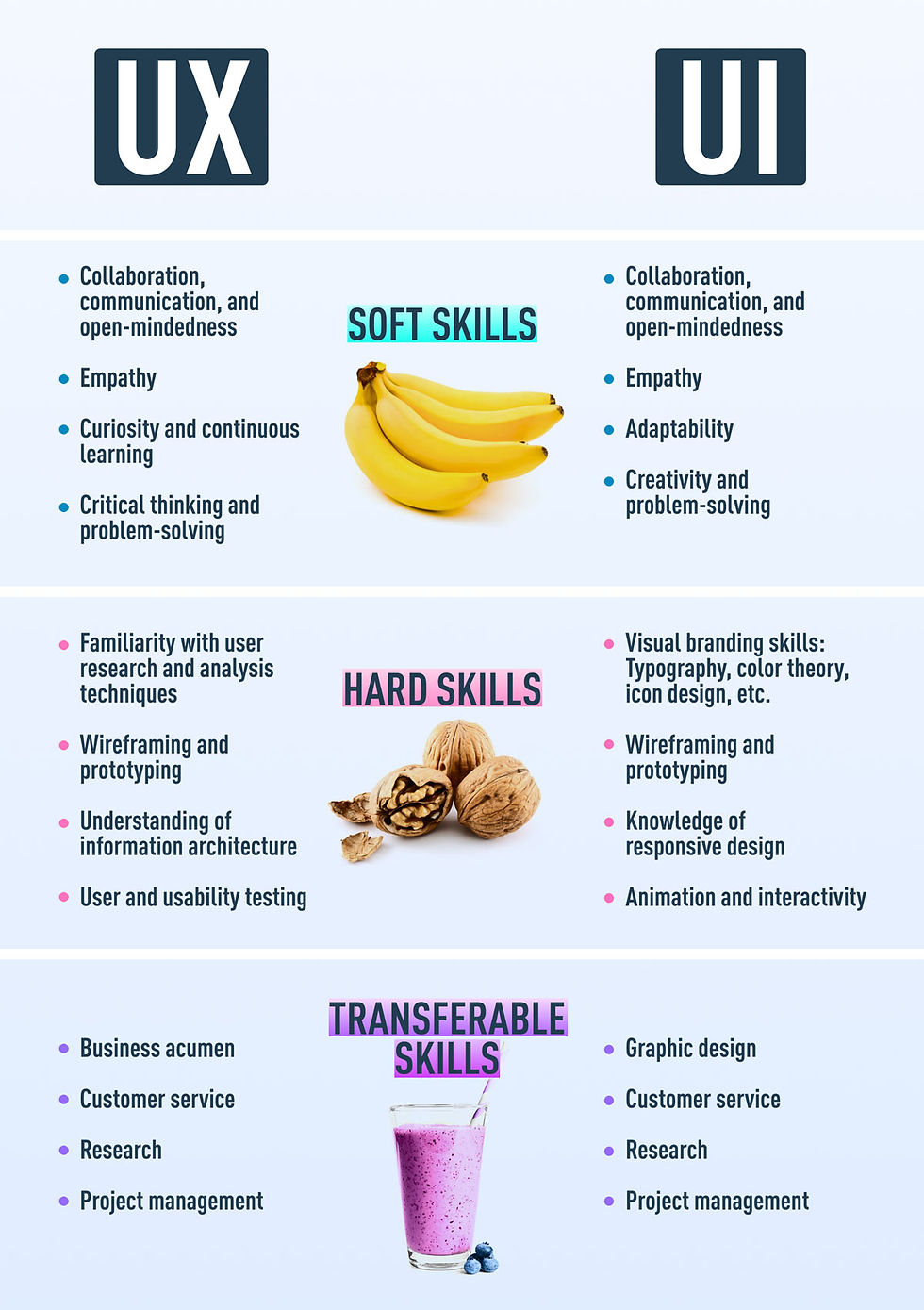
While UX and UI design do go hand-in-hand, you don’t need to be a master of both. If you want to figure out which career path is right for you, it’s important to consider the key skills required by UX vs. UI designers, as well as the typical day-to-day tasks of each. In the following infographic, we’ve highlighted the main hard, soft, and transferable skills for both UX and UI designers. And, in the next sections, we’ll consider the main tasks and responsibilities.
How do I know if UI or UX is a better fit for me?
Both UI and UX design are well-paying careers that are in demand. Which you choose to pursue will depend on your goals and interests. If you’re interested in technology, thrive on variety, and love to solve problems, user experience design might be a good fit. If you’re a creative thinker with a strong aesthetic sense, consider pursuing user interface design.
If you’re still not sure whether UI or UX is a better fit for you, you can:
Take a class in each to experience them for yourself
Read or listen to popular UI/UX blogs and podcasts to hear from experts in each field
Reach out to industry professionals on LinkedIn for an informational interview
Join some online design communities to ask questions
Which is better paid, UX or UI?
Salaries are of course dictated by many factors, though primarily:
Location
Experience
Industry
Project/product type
On average you’ll find that UI and UX jobs have similar salary ranges across startups and minor tech industries. You’ll find, however, that in tech industries outside the web and mobile fields (e.g. car companies, medical equipment manufacturers, etc) there are more and richer opportunities for UI designers, as the field is not only more established but has a more direct, business-driven application.
Average UI Salaries
According to Payscale, the average UI designer salary in the US is $66,074. Base salaries start at $46k for beginners and can be as high as $96k for seniors. If you add bonuses, the salary can be as high as $100k. Also, Payscale has solid info on UI designer salaries outside of the US.
The average salary for UI designers in Germany is €48k (just over $51k).
For the UK, it is £35k ($44k).
In India, it is ₹671k ($9k).

Average UX Salaries
Up next is the UX designer. The average UX designer’s salary in the US is $76,104, just over $10k higher than that of the UI designer.
Base salaries start at $51k, around $5k more than a UI designer’s base salary, and can reach $109k. The difference for senior roles is $13k. With bonuses, this salary can reach $116k.
In Germany situation is a little bit different when it comes to UX designers. According to Payscale, at €45,033 ($48k), the average UX design salary is €3k lower than for UI designers. Also, in the UK, UI design pays more than UX at a total annual salary of £31,748 ($40k).
Unlike America, where UX pays more than UI, India’s situation is like the situation in Europe. On average, UX designers earn ₹600,560 ($7,831), which is ₹71k ($925) less than UI.

Average UI/UX Salaries
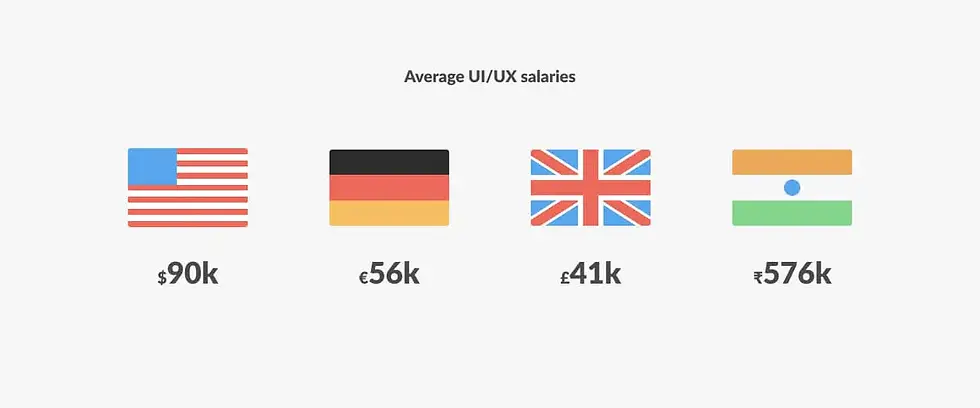
In the US, the combination of UI/UX has the highest average salary ($90,024) among these three roles. The situation is the same in Germany, where UI/UX has a higher average wage than both UI and UX at an average of €56,466 ($60k). However, the difference is not as high as in the US.
The United Kingdom has an average salary for UI/UX designers of £41,467 ($53k). Interestingly, UI/UX actually pays less than both UI and UX in India. The average salary for UI/UX designers in India is ₹576,062 (about $7k).
Other user experience roles
The field of UX extends beyond the two roles of UI and UX designers. If you’re interested in a career in UI/UX, consider these other related roles as well.
UX researchers study the goals, needs, wants, and pain points of a product’s existing and target users.
UX writers write the text that appears on websites, apps, and other digital products.
Interaction designers focus on the ways users interact with digital products in a holistic context.
Developers take the designs from UI and UX designers and code them into usable software, websites, or applications.
Product designers lead the entire process of taking a product or service from idea to reality.
Content strategists oversee the planning and production of marketing content through the lifecycle of a project.

Comments